

 Back to Blog
By Lauren Nagel
Having an accurate estimate of your UAV’s fuel consumption is a key factor in mission readiness and success. This single performance variable will tell you whether your gas powered drone can deliver the package, get to the back corner of the field, or reach your target.

Figure 1: Gas-powered UAV in flight
For flight routes that are just borderline achievable, there are several techniques you can implement to decrease your fuel consumption, increase your range, and boost your confidence in the mission.
Determining how to improve fuel consumption starts with calculating or measuring your UAV’s fuel burn. On more advanced UAVs with built-in fuel flow sensors, this number is easily obtained from your fuel monitoring system.In simpler UAVs without fuel monitoring systems, we can instead borrow some fuel estimation concepts from manned aviation.
In this article we will take you through how to estimate your fuel requirements, how to measure true fuel consumption, and how to decrease your UAV’s fuel consumption / improve its fuel efficiency.
Table of Contents
-
How to Estimate UAV Fuel Requirements
-
Mission profile and performance charts
-
Example problem
-
Taxi, run-up, and take-off
-
Climb
-
Cruise
-
Descent and landing
-
Total fuel requirements
-
Fuel reserve and BINGO time
-
Altitude and wind conditions
-
How to Measure UAV Fuel Consumption
-
UAV fuel flow sensor
-
Flight Replay software
-
Common issues in fuel flow measurement
-
Correct direction of fuel flow
-
Air bubbles in the fuel line
-
Fuel-oil ratio
-
How to Decrease UAV Fuel Consumption
-
RPM and power setting
-
Carburetor tuning
-
Fuel mixture optimization
-
Propeller pitch control
-
Altitude and winds
-
Flight path optimization
-
Engine-propeller matching
How to Estimate UAV Fuel Requirements
Many UAV datasheets report maximum fuel endurance or maximum flight time, but these estimates typically assume ideal conditions. Head winds, humidity, and various flight maneuvers can gradually reduce the maximum flight time minute by minute.
After explaining how each variable affects fuel consumption, we will use an example to demonstrate how you can use reference tables like these to estimate your UAV’s performance, even if your UAV doesn’t come with these charts.
Mission profile and performance charts
This is where we will first draw inspiration from manned aviation. Manned aircraft come with performance specifications that detail the aircraft’s fuel burn in different conditions. Below is an example from a Cessna 172M Skyhawk:

Figure 2: Cessna 172M Skyhawk 1976 POH Cruise Performance Table
As you can see, pressure altitude, temperature, and RPM all have an impact on fuel consumption.
At 10,000 ft at standard temperature, running at 2,400 RPM, the aircraft consumes about 6.4 gph of fuel.
If you were to cruise in the same conditions on a colder day, 20° C below standard temperature or -5° C, you would consume 6.6 gph of fuel. A modest, but potentially meaningful difference.
Now let’s look at the climb performance:

Figure 3: Cessna 172M POH Climb Performance Table
To climb from sea level to 10,000 feet on a day that is standard temperature on the ground, it would take you 25 minutes and you would use 4.5 gallons of fuel. That converts to a fuel burn of 10.8 gph, 69% higher consumption than in cruise flight.
Example Problem
Let’s say we have a 2,300 lb fixed wing UAV, and we know from its datasheet that it burns approximately 5 gph of fuel when in cruise at 10,000 ft ASL and 2,400 RPM. However, we don’t have detailed performance figures or charts beyond this number.

Figure 4: MQ-1 Predator UAV with MTOW of 2,250 lbs
Now let’s say for our mission we want to climb to 12,000 ft ASL, cruise for 30 minutes, then descend directly to landing. The temperature is 35 °C and our launch point is at sea level.
How much fuel do we need to complete the mission?
We can use the charts above to come up with a reasonable estimate, or we can look for similar performance charts for a UAV or aircraft with similar characteristics to our own.
For this article, we will work with the charts in figures 2 and 3.
To keep this example simple, we will assume neutral winds (no head wind or tail wind), but we revisit how wind conditions affect fuel burn in a later section.
We already know that our drone burns about 5 gph of fuel in the same conditions where a Cessna 172M burns 6.4 gph. Therefore our drone burns about 78% as much fuel as our reference aircraft, at least in cruise. For simplicity’s sake, we will assume the same ratio for all phases of flight.
We need to calculate our fuel burn for four phases of flight:
-
Taxi, run-up, and take-off
-
Climb
-
Cruise
-
Descent and landing
Then we can calculate our total fuel requirements and consider our fuel reserve and BINGO time.
Taxi, run-up, and take-off
For a 2,300 lb Cessna 172M with the same mass as our drone, it is estimated that 1.1 gallons of fuel are required for taxi, run-up, and take-off. We will apply our 78% ratio (1.1*0.78), round up, and estimate 1 gallon of fuel used for this phase of flight.
In this exercise we will always round up to add a safety margin.
Climb
For the climb phase, we can use figure 3 to get our estimate. The chart shows that it takes 6.1 gallons to climb to our target altitude of 12,000 feet. We can then apply our 78% ratio (6.1*0.78) to estimate 4.8 gallons.
However, we’re not done there, as climb performance is influenced by temperature, and we are operating on a balmy 35° C day. The Cessna POH states, “The approximate effect of a non-standard temperature is to increase the time, fuel, and distance by 10% for each 10° C above standard temperature, due to the lower rate of climb.”
Therefore, we must increase our fuel burn estimate by a full 20% as we are 20° C above standard temperature.
4.8*1.2 = 5.76, and we will round up to 6 gallons to give us a small safety margin.
Cruise
Calculating cruise fuel burn is straightforward - we can pull our base number from figure 2: at 2,400 RPM, 12,000’, and 20° C above standard temperature, the fuel consumption for a 172M is 6 gph. Since we are cruising for 30 minutes this would be 3 gallons total, multiplied by 78% to give 3*0.78 = 2.34, which we will round up to 2.5 gallons.
Descent and landing
The POH does not contain a specific section on descent fuel burn, but we can still use the charts to derive an estimate. In a descent, a lower power setting is used, so we can use the lowest setting provided in the cruise chart as a reference, which is 2,200 RPM.
The fuel burn at 2,200 RPM differs at our starting altitude (5.3 gph at 12,000’) and the lowest altitude in the chart (6.1 gph at 2,000’). We will choose a conservative average middle ground of 5.8 gph for our calculations.
A descent rate of 500 feet / minute offers a comfortable rate of descent, and from 12,000 feet to sea level that would take 24 minutes. (24/60)*5.8 = 2.32; 2.32*0.78 = 1.8 gallons, which we will round up to 2 gallons.
We will assume that we fly a straight-in landing and that the fuel required to land is already included in this descent calculation.
Total fuel requirements
If we put together all of our estimates, our total fuel requirements for this mission are:
-
Taxi, run-up, and take-off: 1 gallon
-
Climb: 6 gallons
-
Cruise: 2.5 gallons
-
Descent and landing: 2 gallons
Total = 11.5 gallons of fuel required.
Fuel reserve and BINGO time
There are two other factors to consider when estimating the fuel required for our mission.
The first is what size of fuel reserve we would like to have onboard when we land. In manned general aviation, it is recommended to have at least 30 minutes of fuel on board at landing for daytime VFR flights, or 45 minutes worth of fuel for night VFR flights.
With uncrewed missions, we don’t need to be as strict as there are no souls on board, though presumably we do want to recover our drone. Accordingly, for this mission, let’s say we want to land with 15 minutes of fuel, which at cruise is equivalent to 6.4*(15/60)*0.78 = 1.25 gallons, which we will round up to 1.5 gallons.
To ensure our drone has enough fuel to land with a safety margin, we would make sure we have at least 13 gallons of fuel (11.5 + 1.5) on board at the start of this mission.
BINGO time allows us to determine when we need to turn back and return to base in order to land with the fuel reserve we specified. BINGO time ensures that no matter where we are in our mission, if we turn back immediately we can make it back to base with at least 15 minutes of fuel in our tank.
To calculate BINGO time, we first determine the distance between our home base / refueling station and the furthest point in our mission. Let’s say that’s 10 miles. Then we determine how much time is required to fly that distance. Based on our cruise performance charts, we can estimate that we are flying at about 100 knots, or 115 mph. To cover 10 miles, it will take us just over 5 minutes, or about 0.5 gallons of fuel.
We add this travel time (5 mins) to our reserve (15 mins), and note that we need to turn back to base when we are down to 20 minutes of fuel on board. If we are taking off with 13 gallons of fuel, and we assume an average burn rate of 5 gph, this puts us at ~2.6 hours (2 hours and 36 minutes) of fuel on board. Therefore, we need to turn back to base after 2 hours and 16 minutes (2 hours and 36 minutes - 20 minutes).
The BINGO time countdown starts as soon as we start our engine. If we start the drone’s engine at 10:00, our BINGO time is 10:00 + 2 hours 16 minutes, so our UAV would turn back to base no later than 12:16.
Altitude and wind conditions
Wind conditions must also be taken into account for an accurate fuel consumption analysis, especially if the mission is route-based rather than time-based. Headwinds will slow down your UAV and increase fuel consumption per mile, while tailwinds have the opposite effect.
There are numerous apps you can use to determine the wind speeds and conditions at your target altitude, such as the Windy app or your local aviation weather provider (NAV CANADA, AWC, etc.).

Figure 5: Windy app desktop interface with altitude-specific wind speed
The increased fuel consumption is calculated by determining how much longer the mission will take in those conditions, and brings in the concept of airspeed vs. ground speed.
Airspeed measures the aircraft’s speed relative to the surrounding air, while ground speed is the actual speed relative to the Earth's surface below. At constant throttle, airspeed doesn’t change with a headwind or tailwind, whereas ground speed does.
For example, flying a 50 mile route at an airspeed of 115 mph with no wind would take us about 26 minutes. However, if we add a 15 mph headwind, our ground speed decreases to 100 mph, and that same route would take us about 30 minutes.
If we are cruising at 10,000 feet with a fuel burn rate of 5 gph, that comes out to a difference of about 0.3 gallons (2.2 vs. 2.5 gallons) for that leg of the mission.
On critical missions, small differences such as these can impact your payload, range, and whether your drone makes it back safely or not.
How to Measure UAV Fuel Consumption
The variables used in the last section can be used to calculate an estimate of your UAV’s fuel requirements. However, modelling can only get you so close to real fuel burn, especially without drone-specific performance data.
In Hyokawa et al, for example, a method for estimating UAV fuel consumption was explored. While the authors deemed the method valid, with the actual fuel burn (0.05 g/s) falling just within the estimated range of 0.04-0.1 g/s), the upper end of the range was 150% higher than the lower end, thus not particularly precise.
To get a much more accurate estimate of your drone’s fuel requirements, we recommend using a UAV engine test stand, which incorporates a UAV fuel flow sensor and a flight replay function, which can help you measure fuel burn in similar conditions to your flight. More details below.
To test your UAV’s propulsion system with the stand, simply mount your engine and propeller using the engine mounting plate provided, and connect your fuel tank to the fuel flow sensor.

Figure 6: Flight Stand 60 engine test stand
UAV fuel flow sensor
The fuel flow sensor included with the Flight Stand 60 engine test stand can measure fuel flow rates between 20 - 800 mL/min, with a resolution of 1 mL/min.
This is a turbine type fuel flow sensor that works by spinning an internal impeller as fuel passes through it, where the rotation speed is proportional to the flow rate.
Flight Replay software
The Flight Stand software is included free of charge with the Flight Stand 60 engine test stand.
One of the software’s most useful features for UAV engine testing is called the flight replay feature, which allows you to upload throttle controller data from a previous flight so you can replay the throttle pattern while your engine is hooked up to the stand. The video below demonstrates how this feature works.
Figure 7: Flight replay interface in the Flight Stand software
This gives you a solid estimate of your drone’s fuel burn during that specific flight, and dynamic conditions can be added using a wind wall to create even more realistic conditions.
Common issues in fuel flow measurement
Direction of fuel flow
There are a few issues to watch out for when measuring UAV fuel flow. The first is ensuring the fuel flow sensor is connected with fuel flowing in the correct direction. The sensor includes arrows to indicate in which direction the fuel should flow between the fuel tank, sensor, and engine.
Air bubbles in the fuel line
The second issue is the presence of air bubbles in the fuel line. To minimize air bubbles in a UAV fuel system, ensure all fuel lines, tank fittings, and connections are properly sealed and free of cracks, as even small leaks can allow air to be drawn into the system. Regularly inspect and replace aging fuel tubing, verify that the tank pickup (clunk) remains submerged throughout the flight, and route fuel lines away from hot components to reduce fuel vaporization and bubble formation.
Fuel-oil ratio
Finally, it is essential to have the correct oil-fuel ratio if you are using a two stroke engine. This ratio may be different during the break-in phase and regular operation, so check your engine’s user manual for instructions. Getting this ratio right will help to avoid under-lubrication and carbon buildup, ensuring smoother performance and uninterrupted tests.
How to Decrease UAV Fuel Consumption
Now that we know how to estimate and measure UAV fuel flow, let’s look at how we can optimize it.
Below are 7 ways that you can improve UAV fuel consumption.
1. RPM and power setting
One of the simplest ways to reduce fuel consumption is to operate the engine at its most efficient RPM rather than at maximum power.
In a 2025 study by Öztürk and Öncü, researchers evaluated a two-stroke UAV engine under different propeller and RPM combinations between 3,000 and 5,000 RPM. They identified an optimal operating point of approximately 4,000 RPM. At this setting, fuel consumption during a representative four-hour mission decreased from 2.51 L to 1.86 L, while overall performance improved by 47%.
The study also found that increasing RPM beyond the optimal range produced diminishing returns in thrust while significantly increasing fuel consumption and engine temperature. For long-endurance missions, selecting the lowest power setting that still meets airspeed and payload requirements can substantially improve fuel economy.
2. Carburetor tuning
Proper carburetor tuning can have a surprisingly large effect on fuel consumption, especially on two-stroke engines.
An overly rich mixture wastes fuel and can cause carbon buildup, while an excessively lean mixture may lead to overheating, detonation, or engine damage. Small adjustments to the high-speed and low-speed needles, often as little as ⅛ to ¼ turn, can dramatically improve engine smoothness, throttle response, and fuel efficiency.
When tuning a carburetor, adjustments should be made gradually while monitoring engine temperature, RPM, and fuel consumption. An engine test stand equipped with a fuel flow sensor makes this process significantly easier and allows changes to be quantified rather than judged by feel alone.
3. Fuel mixture optimization
Fuel-air ratio optimization offers another opportunity to reduce fuel consumption.
Mahadevappa et al. investigated methods of extending fixed-wing UAV endurance through automated engine management. Their work demonstrated that combining fuel mixture control with variable pitch propeller operation allowed endurance increases of up to 12 hours in long-endurance UAV platforms.
More advanced systems can automate this process. Wang et al. developed a fuel supply strategy based on closed-loop air-fuel ratio (AFR) control using a fuzzy-PID controller. Compared with traditional open-loop fuel calibration methods, the AFR-controlled system improved power efficiency by 9-33% while increasing endurance by approximately 30 minutes. The closed-loop approach also improved engine stability and reduced transient fuel consumption during throttle changes.
For UAVs equipped with electronic fuel injection systems, AFR monitoring and automated mixture control can significantly improve fuel economy while maintaining consistent engine performance.
4. Propeller pitch control
The propeller plays a major role in determining how efficiently engine power is converted into thrust.
Fixed-pitch propellers are optimized for only a narrow range of airspeeds and operating conditions. Variable-pitch propellers, by contrast, allow blade angle to be adjusted throughout the flight, helping the propeller maintain higher aerodynamic efficiency during climb, cruise, and descent.
Stevenson et al. compared fixed-pitch and variable-pitch propulsion systems and found that variable-pitch propellers consumed less energy during cruise flight. In seven flight tests using the same airframe and similar flight conditions, the variable-pitch system consistently required less energy than the fixed-pitch configuration, reducing normalized energy consumption by roughly 12-23% depending on the test conditions. By adjusting blade pitch based on RPM and airspeed, the propulsion system operated closer to its optimal efficiency point throughout the mission.
While variable-pitch systems add complexity, weight, and cost, they can provide meaningful endurance improvements for long-range UAV operations.
5. Altitude and wind conditions
Environmental conditions can have a significant effect on fuel consumption.
Flying into a headwind increases the time required to complete a route, increasing fuel consumption even if throttle settings remain unchanged. Tailwinds have the opposite effect and can substantially extend range.
Altitude also affects fuel burn. Higher altitudes generally reduce air density, which decreases aerodynamic drag and can improve cruise efficiency. However, reduced air density also lowers engine power output and propeller thrust. The optimal cruise altitude depends on the specific engine, airframe, and mission profile.
Before a mission, review forecast winds at your intended operating altitude, as selecting an altitude with more favorable winds can provide significant endurance gains.
If you want to validate your drone's performance in different wind conditions before heading outside, a WindShaper wind wall is a great way to create those conditions indoors.

Figure 8: Testing UAV Wind Performance with a WindShaper
6. Flight path optimization
The shortest route is not always the most fuel-efficient route.
Sharp turns, frequent altitude changes, and aggressive maneuvering all increase fuel consumption. Smoother flight paths reduce drag, lower load factors, and allow the aircraft to remain in its most efficient operating regime.
Roberge et al. demonstrated this concept using particle swarm optimization (PSO) to optimize UAV power settings along surveillance trajectories. Their algorithm combined three-dimensional path smoothing with optimized power management while respecting aircraft performance limits. The resulting trajectories reduced fuel consumption by as much as 25% compared with conventional flight planning methods.
For autonomous UAVs, route optimization software can provide substantial endurance gains with no hardware modifications whatsoever.
7. Engine-propeller matching
Even a highly efficient engine will waste fuel if it is paired with the wrong propeller.
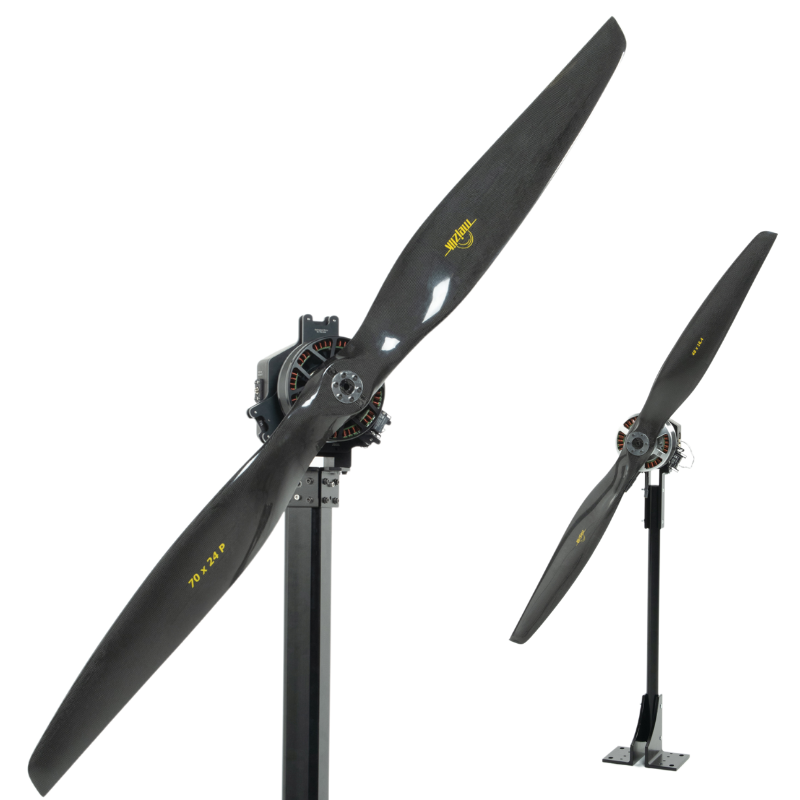
The engine, propeller, and airframe should be viewed as a complete propulsion system. A propeller that is too small may force the engine to operate at unnecessarily high RPM, while a propeller that is too large can overload the engine and reduce efficiency.
The work of Öztürk and Öncü highlighted the importance of proper engine-propeller matching. Their analysis showed that propeller selection had a major impact on engine behavior, accounting for approximately 86% of observed engine temperature variation. Optimized propeller configurations also reduced fuel consumption by roughly 7%.
When selecting a propulsion system, evaluate fuel consumption, thrust, and operating temperatures together. Small changes in propeller diameter or pitch can often produce measurable improvements in endurance without requiring any modifications to the engine itself.
Conclusion
Improving UAV fuel efficiency is rarely about a single modification. Instead, the greatest gains typically come from combining accurate fuel consumption measurements with optimized engine settings, propeller selection, flight planning, and operating procedures. By understanding how your UAV consumes fuel and validating performance through real-world testing, you can increase endurance, extend range, improve mission reliability, and make more effective use of every litre of fuel onboard.


Leave a comment